BAASNA AG004 - Sacred Scarab
0
Shipping is calculated at checkout
Choose Size
Description
Animal: Sacred Scarab
A Study in Ancient Egyptian Perfumery
The Animal Was Only the Beginning
The sacred scarab immediately connects to ancient Egypt, but the creative challenge was to avoid creating merely an "Egyptian-themed perfume."
The project became an investigation into the insect, its symbolism and ancient Egyptian perfumery simultaneously.
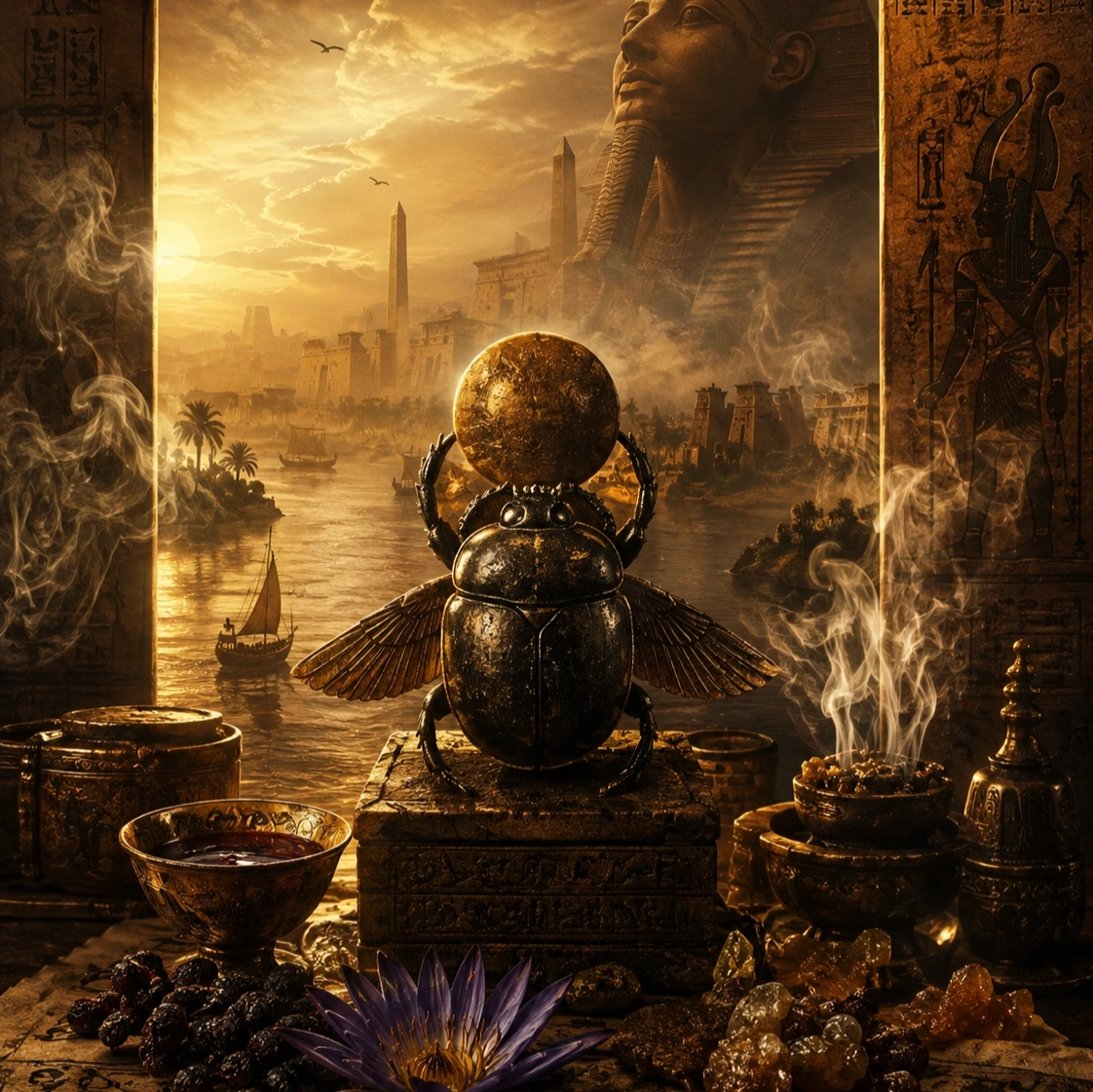
The physical behaviour of the scarab also provided an extraordinary image.
The scarab rolls a ball into an underground chamber where it lays its eggs.
That physical image was connected to kyphi, the ancient Egyptian incense, which was historically prepared into balls.
The result became an imagined scene: a sacred scarab rolling a fragrant kyphi ball into an underground tomb.
Researching Kyphi
Kyphi became the foundation of the study.
Historical accounts describe formulations containing combinations of: wine, honey, raisins, frankincense, myrrh, galbanum, styrax, cassia, labdanum, benzoin, juniper and cedarwood.
Different historical preparations used different proportions.
The research therefore involved studying historical accounts, attending Egyptology seminars focused on ancient Egyptian smellscapes, examining reconstructed kyphi and making kyphi balls to better understand the material itself.
The Discovery of Wine
One particularly important observation was that wine was not merely a binding ingredient.
It also contributed a sweet fruity character to the incense.
That realization changed the structure of the perfume.
The wine-like sweetness became part of the backbone of the composition rather than simply an incidental historical detail.
Modern Opening, Ancient Foundation
The composition deliberately creates a temporal contrast.
The opening is relatively modern and luminous, particularly through blue lotus and aldehydic effects.
The base feels ancient because of the reconstructed kyphi concept.
This creates the description: a modern floral chypre with ancient roots.
The Regal Dimension
The composition was also intended to feel regal, almost worthy of Cleopatra.
This explains the emphasis on richness, floral luminosity, resin, incense and chypre structure.
The goal wasn't merely archaeological accuracy.
It was an olfactory interpretation of royalty, ritual and antiquity.
The Architecture
Blue lotus / aldehydic luminosity
↓
Floral chypre
↓
Wine / honeyed sweetness
↓
Kyphi
↓
Frankincense / myrrh / resins / woods
Perfumery Study Note
Sacred Scarab is an example of historical research becoming formulation. The ancient material isn't used merely as a story; its reconstruction determines the fragrance's structural backbone.
Olfactory Profile
Notes |
Aldehydes, Civet, Lemon, Wine, Blue Lotus, Plum, Benzoin, Frankincense, Amber, Musk, Raisin, Cedarwood, Galbanum, Labdanum, Myrrh, Oakmoss, Styrax, Juniper |
Olfactory Family: Oriental Floral Fragrance
Gender Orientation: Unisex
Concentration: Extrait
Research Reference
Study based on the original fragrance, published perfumer interview and available technical discussion surrounding its development. This study is presented for educational and olfactory research purposes. BAASNA's interpretation is not the original formulation.
Categories: ORIENTALFLORALFEMININE FRAGRANCESMASCULINE FRAGRANCESUNISEX FRAGRANCESAVANT-GARDE ARCHIVE
Brand: Inspired by Zoologist
SKU: AG006D, AG006S
*** Our crafted perfumes and aromatic oils are artisanal interpretations inspired by the essence, mood, and olfactory character of well-known fragrances. Each creation is independently developed and reflects BAASNA's own perfumery vision.
BAASNA is not affiliated with, endorsed by, or connected to any designer brands, manufacturers, or trademark holders referenced within this archive. All trademarks and copyrights remain the exclusive property of their respective owners.
Brand names are used strictly for comparative and educational reference, allowing clients to better understand scent direction and fragrance family. No claim is made of identity, duplication, or originality beyond our own formulations. ***
*** Our crafted perfumes and aromatic oils are artisanal interpretations inspired by the essence, mood, and olfactory character of well-known fragrances. Each creation is independently developed and reflects BAASNA's own perfumery vision.
BAASNA is not affiliated with, endorsed by, or connected to any designer brands, manufacturers, or trademark holders referenced within this archive. All trademarks and copyrights remain the exclusive property of their respective owners.
Brand names are used strictly for comparative and educational reference, allowing clients to better understand scent direction and fragrance family. No claim is made of identity, duplication, or originality beyond our own formulations. ***